

We Got Grit All Wrong
It's Not a Trait; It's a Condition

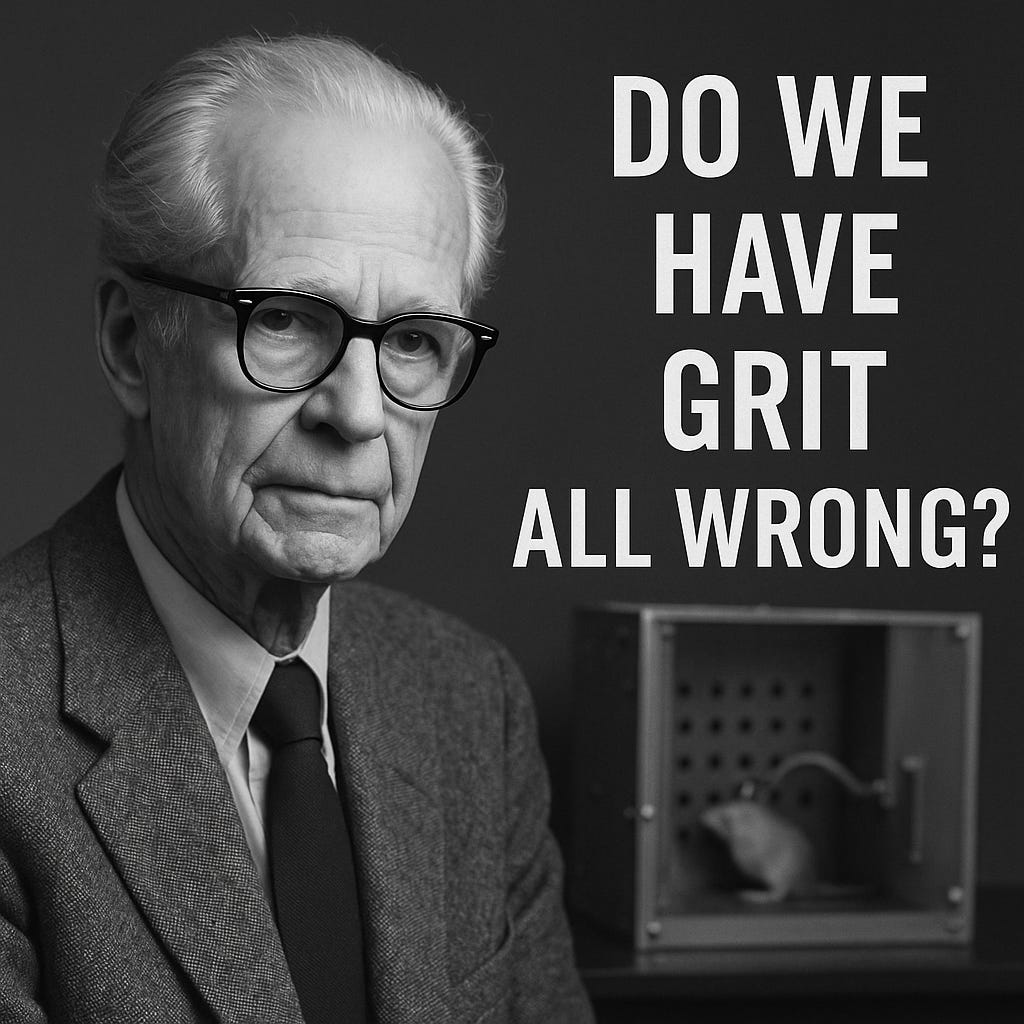
Grit has carved out a permanent place in our cultural vocabulary. The ethos is oversaturated with apps, products, articles (including this one), and podcasts about grit; how it relates to failure, how grit predicts success, and why we should all be chasing it.
Yet somehow, grit remains misunderstood and not systematically attainable.
Stick with me, because I’m about to explain grit in a way that will make you a better parent, coach, and professional.
Grit exploded into our vernacular only recently. Duckworth and colleagues (2007) in their foundational study defined grit as “perseverance and passion for long-term goals.”
They went on to explain that grit consists of two parts, the ability to keep working despite setbacks, and consistency of interest. Perseverance is the short-term engine; grit is the long-term pattern.
Thanks to Maddi et al. (2002) and Duckworth et al. (2007), among others, we know that grit matters. Grit outperforms every other variable for predicting West Point completion. Grit beats IQ when predicting National Spelling Bee performance. Grit predicts teacher effectiveness better than academic achievement or interview scores. Student retention is more influenced by grit than by standardized test scores.
Grit is the number-one non-cognitive indicator of long-term success.
But here are the important and relatively unanswered questions:
If you have grit, where did you get it?
If you don’t, how do you develop it?
Over a 20-year coaching career, I’ve leaned heavily on my roots in psychology to answer questions like these. I can’t recall the exact study, but I read a classic experiment that planted the seeds for understanding grit while studying Psychology at Clarion University:
Researchers wanted to see which reinforcement pattern produced the most persistent teeth-brushing behavior in children once the reward was removed. The reward was small, a quarter or some other token. Three reinforcement patterns were tested: never rewarded, always rewarded, and rewarded only occasionally.
When the reward was removed, the children who continued brushing their teeth the longest came from the intermittent reinforcement group.
This phenomenon is known as the Partial Reinforcement Extinction Effect (PREE). PREE states that behaviors reinforced intermittently persist far longer after reinforcement stops than behaviors reinforced continuously or not at all. We see this all the time, particularly at casinos and specifically at the slot machines.
PREE was formalized later, but it has it’s roots back to the 1930s, when B.F. Skinner formalized the concept of operant conditioning. Building on Pavlov’s work, Skinner professed that most human behavior is shaped not by reflexes, but by the consequences of our actions over time. Skinner’s work laid the foundation for understanding why intermittent reward, success that comes unpredictably, creates the strongest possible persistence.
UNDERSTANDING GRIT THROUGH PREE
For nearly two decades, grit has been framed as a personality trait. It’s either something you possess naturally, maybe by genetics, or it’s something you cultivate through motivational messages, passion, will power or persistence itself. But once you understand grit through the lens of PREE, grit stops being abstract.
It becomes measurable, predictable, trainable, and attainable.
Behavior is most persistent when rewards are intermittent. Not constant. Not absent. Intermittent, every now and then.
Gritty people aren’t superhuman, and they weren’t born with it. They’re simply the result of a history where success came
occasionally
only after effort
unpredictably and
often after failure.
Why? What is the mechanism?
Intermittent success teaches the brain that:
periods of time without a reward are normal
failure is necessary
effort without immediate payoff is expected
the next success might be right around the corner
That is the psychological foundation of grit: learned persistence in the face of frustrating and/or uncertain outcomes.
This matters because it gives parents, coaches, and leaders the ability to deliberately design environments that create grit.
If someone always succeeds, they become fragile - they break
If someone never succeeds, they become hopeless - they quit
If someone sometimes succeeds, they become persistent - they maintain
Once you understand grit this way, you can build it intentionally.
Now the role of failure makes sense.
This is invaluable. When your athletes, students, children, or clients hear you say “failure is part of the process,” they don’t want to hear it.
Rephrase it for them:
Failure is a necessary ingredient in grit
Grit is perhaps the most necessary ingredient in long-term success
APPLYING PREE TO A YOUNG SWIMMER
Now, let’s shift to competitive swimming.
Grit = persistence of effort over time
Reward = achieving a goal time
Failure = missing that goal time
Reward Schedule = the pattern of achieving vs. not achieving those goals
Desired Outcome = develop a high level of grit
If we want to develop grit, we must understand what happens psychologically when an athlete:
always hits their goal times
never hits their goal times
sometimes hits their goal times
According to PREE, it is the unpredictable mix of success and failure that produces the strongest persistence.
You cannot develop grit without failure.
But you also cannot develop grit without success.
It is the tension and relationship between those two experiences that builds the kind of student, athlete, or professional who keeps showing up and keeps giving great effort.
And that is grit, demystified.
It’s time to move past grit as a buzzword and into a realm where parents, coaches, and athletes understand what it is, how it is formed, and why failure should never be a dirty word or a reason to walk away.
Grit isn’t optional for long-term success. Research is showing this with increasing clarity and certainty.
If your mission is to develop strong student-athletes who can do anything they put their mind to, then the development of grit should be a visible and tangible part of your program.
If you’re interested in making grit an intentional part of your team’s culture, I’d be happy to help you build it
.
Another great article Doug !